Climate Change Initiatives
Basic Stance
As we work toward a sustainable society, addressing climate change has become a global challenge. JGC Group has identified "societies in harmony with the environment" as a materiality. Besides taking climate action through environmentally conscious business activities, the JGC Group studies and formulates business strategies accounting for scenario analysis in recommendations of the Task Force on Climate-related Financial Disclosures (TCFD).
Climate change related disclosure
In participating in international frameworks for climate change disclosure, the JGC Group has responded to CDP surveys since 2021 (when the Group received a B rating in fiscal 2025) and has followed TCFD disclosure guidelines as a supporter, including securities reports.
For further information, refer to JGC's CDP Climate Change 2025 Response[PDF:1.03MB].


Governance
The JGC Group responds to climate change under the leadership of the representative director, chairman, and president, who is responsible for ensuring that environmental issues are addressed in Group business strategies and targets. One facet of this is assessing and managing climate-related risks and opportunities. Accordingly, the long-term management vision and medium-term business plan announced in May 2021 were established through Board discussions based in part on results of climate change scenario analysis and an assessment of these risks and opportunities. Monitoring of climate change issues is conducted by the Sustainability Committee, which formulates policies and action plans related to sustainability, including the Group response to climate change, and deliberates to evaluate and promote relevant action. Under the Committee, two subcommittees have been established: the “GHG calculation subcommittee” and the “CO2 reduction Subcommittee.” These subcommittees report on and review the status of greenhouse gas emissions and progress on reduction measures, thereby promoting risk mitigation and prevention.
Strategy
The JGC Group recognizes risks and opportunities related to climate change, which are reflected in strategies.
Recognition of Climate-Related Risks and Opportunities
Based on data from the International Energy Agency (IEA)’s “World Energy Outlook 2020,” our Group conducted an analysis targeting 2040, using multiple scenarios including the Stated Policies Scenario (STEPS) and the Sustainable Development Scenario(SDS), through which we have evaluated climate change-related risks and opportunities, and we will reflect these in our strategy.
| New regulatory risks | The introduction of global carbon pricing may lead to higher equipment and fuel costs, which could affect business costs in the future. In addition, the introduction of carbon taxes and the strengthening of national carbon emission targets are recognized as risks that could reduce order opportunities due to decreased demand for plants in the oil & gas sector. |
|---|---|
| Technology risks | Lower gasoline demand from the spread of EVs and fuel cell vehicles poses a risk of fewer contract opportunities for plants in the oil & gas industry. A similar risk is posed by the spread of decarbonized materials and a shift to renewable energy driven by the spread of high-performance storage batteries. |
| Regulatory risks | It is anticipated that legal obligations for information disclosure related to climate change measures will expand, increasing the burden of reporting and other requirements. Furthermore, in the event of non-compliance, there are risks such as penalties and the invalidation of permits and licenses related to construction. |
| Market risks | Lower plant demand in the oil & gas industry may result in fewer contract opportunities. An aversion in financial and capital markets to business related to fossil fuels also poses a risk that projects may not be approved. |
| Policy and legal risks | Failure to maintain or build on our reputation as an enterprise with the technical expertise to contribute to climate change solutions such as carbon reduction, renewable energy, and hydrogen applications may adversely affect the JGC Group in various ways, such as contract opportunities, financing, or securing human resources. |
| Acute physical risks | More frequent extreme weather events such as heavy rain, storms, typhoons, and flooding attributed to climate change may physically damage materials, equipment, and JGC Group facilities, adversely affect employees, and delay procurement. |
| Chronic physical risks | Higher average temperatures may make longer construction periods more common, due to lower labor productivity at construction sites in temperate and tropical regions, which could increase project costs and affect clients’ investment decisions. Another concern is increased costs for countermeasures and accident compensation, due to higher occupational safety risks. There is also a risk of higher shipping costs from a lack of ports if sea levels rise in coastal areas. |
| Products and services | By applying CCS (CO2 capture and storage) technologies, which have proven track records both domestically and internationally, as well as CCUS (CO2 capture, utilization, and storage) technologies being jointly developed with other companies, to the oil & gas sector, it is expected that plant demand in this field will be stimulated and contract opportunities will increase. |
|---|---|
| The JGC Group has an extensive record in renewable energy plants such as solar and biomass power plants, which, as the international community shifts toward decarbonization, may increase contract opportunities. | |
| In fields such as hydrogen, ammonia, and small modular reactors (SMRs), which do not emit CO2, our Group has been advancing various initiatives toward a decarbonized society, including technological development, and an increase in contract opportunities can be expected in the future. | |
| Greater worldwide demand for a circular economy can be expected to drive demand for technologies under development by the JGC Group, which include chemical recycling of plastic waste, recycling of fiber waste, and SAF. |
Scenario Analysis
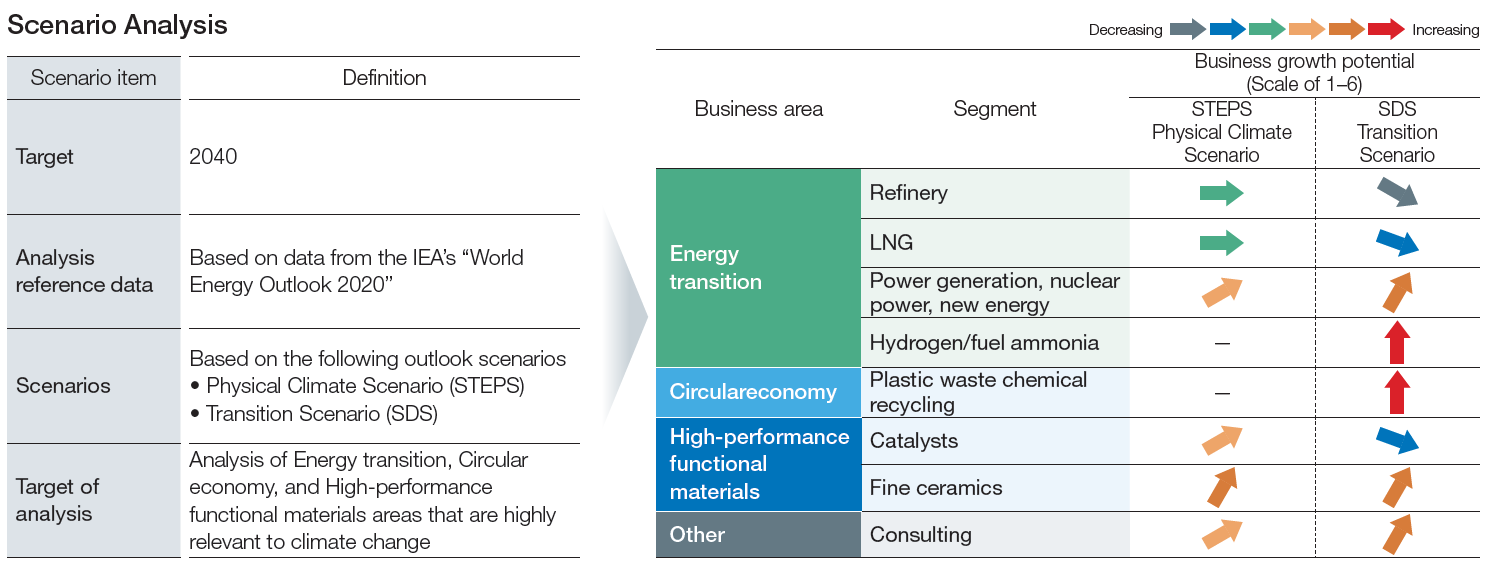
In addition, with the formulation of the climate transition plan in mind, we plan to review the scenario analysis aligned with the 1.5°C target of the Paris Agreement, while taking into account trends such as the revision of the Japanese government’s Basic Energy Plan and the Nationally Determined Contributions (NDC).
Business areas contributing to achieving societies in harmony with environment (2040 Vision)
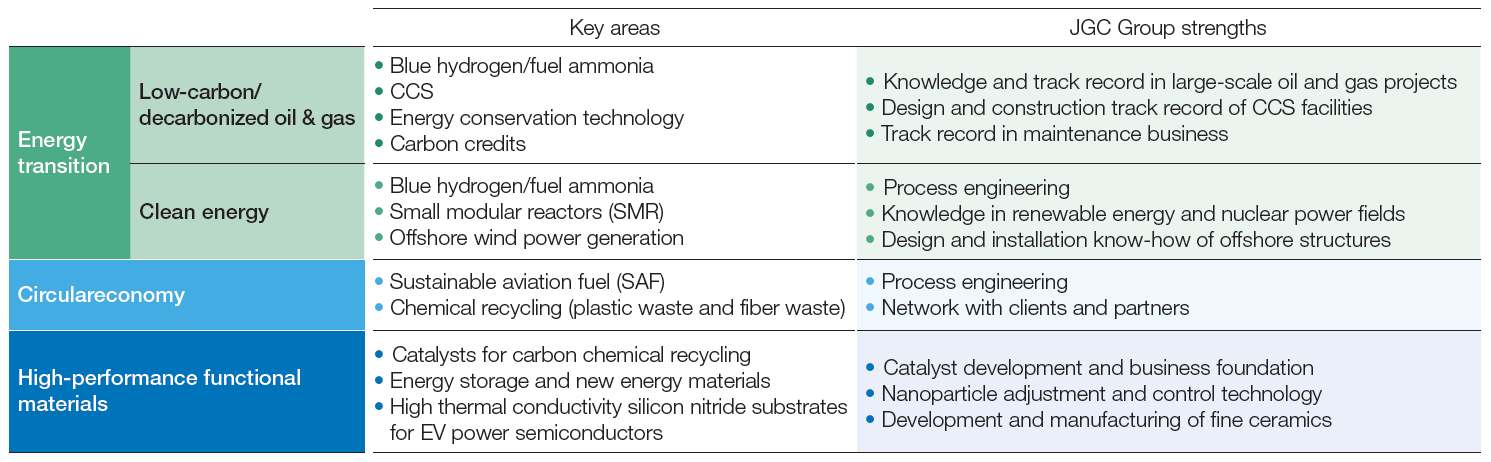
Based on a recognition of the above risks, opportunities, and scenario analysis, our long-term management vision “2040 Vision” positions the following focus areas within energy transition, circular economy, and high-performance functional materials as business domains that contribute to the realization of “societies in harmony with environment.”
Using Green Bond to Promote Business to Achieve Societies in Harmony with Environment
On September 19, 2023, the JGC Group issued green bonds totaling \10 billion as a means to raise funds to allocate to new green projects.
We believe that the issuance of these green bonds will provide an opportunity for investors and society to broadly recognize our Group’s commitment to contributing to the creation of economic, social, and environmental value through addressing social issues via our business activities.
Risk Management
In addition to being deliberated by the Sustainability Committee, the Group Risk Management Committee also identifies and organizes all risks of our Group, including sustainability-related risks, maintains and builds the risk management system, and proposes and deliberates on improvements.
Metrics and Targets
Commitment to Carbon Neutrality by 2050
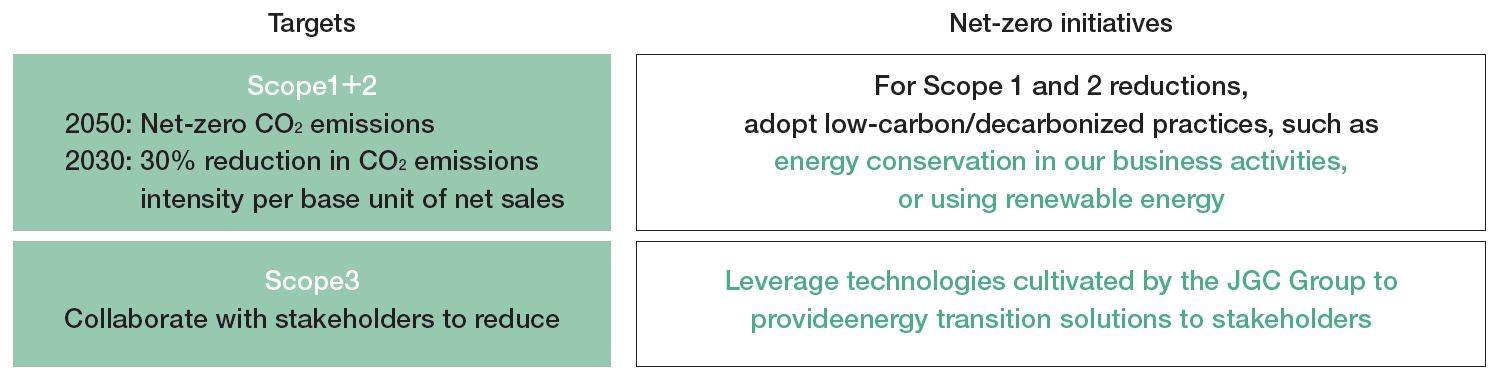
While the core domain of the JGC Group has long been Oil & Gas, we announced our "Commitment to Carbon Neutrality by 2050" in 2020 as a sign of our dedication to enhancing corporate value in a sustainable manner through transformation toward achieving planetary health.
Targets in the commitment to carbon neutrality by 2050
GHG emissions results
- For the GHG emissions results of fiscal year 2024, as part of efforts to improve reliability, (1) JGC Holdings Corporation and JGC Corporation added emission sources subject to measurement, and (2) JGC Corporation and JGC Japan Corporation reviewed the scope of GHG emissions aggregation based on the operational control approach defined in the GHG Protocol. As a result, emissions from subcontractors, which had previously been included, were excluded from theis measurement of GHG emissions for fiscal year 2024 and will be measured as Scope 3, among other revisions to the calculation method. As a result, the actual Scope 1+2 emissions for fiscal year 2024 were 115,743 t-CO2 compared to 133,695 t-CO2 in fiscal year 2023 (disclosed value). However, when compared with an estimated figure of 109,007 t-CO2 calculated under the same conditions as this year, the main reason for the increase was that large-scale construction projects at JGC Corporation were at their peak. For the estimated values under the same conditions as the GHG emissions for fiscalis year 2024 for fiscal year 2020 (base year) and fiscal year 2023, the estimates include extrapolations due to data limitations for past years.
Additionally, all emission results are disclosed only as reference totals of emissions independently calculated by each company, including our company, JGC Corporate Solutions Co., Ltd., JGC Corporation, JGC Japan Corporation, JGC Catalysts and Chemicals Ltd., Japan Fine Ceramics Co., Ltd., and Japan NUS Co., Ltd., for the purpose of identifying emission sources and amounts and considering reduction measures. We will continue efforts to improve the reliability of these figures.
| Fiscal year | 2020 (Base year) | 2023 | 2024 | ||
|---|---|---|---|---|---|
| Reported number | Estimated number | Reported number | Estimated number | ||
| Scope1+2 (t-CO2) In Scope 1 In Scope 2 |
132,546 84,325 48,221 |
(111,381) (70,906) (40,475) |
133,695 83,729 49,966 |
(109,007) (65,115) (43,892) |
115,743 73,462 42,281 |
| Emissions intensity per base unit (t-CO2 /net sales billion yen) |
30.55 | (25.67) | 16.06 | (13.09) | 13.49 |
| Year-on-year comparison of emissions intensity per base unit | — | — | -47% | (-49%) | (-47%) |
| Scope3 (t-CO2) | Not reported | — | 1,497,309 | (1,524,862) | 1,569,452 |
- The estimated values under the same conditions as fiscal year 2024 and the results of comparing unit-based emissions based on these estimates are shown in parentheses in the table above.
- Scope 3 does not include emissions of Category 11 (use of sold products) and categories determined by the Company to be not relevant.
- For details on the assumptions and breakdowns used in calculating these emissions, please refer to our Group’s response to CDP 2025 (Module 7: Environmental Performance - Climate Change section), an international framework for climate change-related information disclosure. As a result of reviewing and verifying our GHG emissions data to enhance reliability, certain figures above have been partially revised from those reported in our CDP 2025 response.
Promoting the management and reduction of GHG emissions
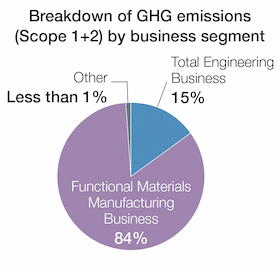
Our Group is working to reduce GHG emissions as a common Group issue, using unit emissions per sales (target: 30% reduction compared to fiscal year 2020) as a common indicator, and has achieved certain results. On the other hand, given the reality that total emissions have not decreased, we will manage and promote effective GHG emission reduction activities in a manner tailored to the actual situation of each Group company, taking into account the characteristics of each business segment.
Total Engineering Business
Characteristics
- GHG emissions fluctuate each year depending on the status, number, and scale of EPC projects, making them difficult to predict.
- Because the construction site changes every few years, it is difficult to implement permanent measures.
Main reduction activities
- Yokohama HQ: Upon participating in the METI GX League, we submitted GHG emissions reduction targets for the Yokohama HQ, our main business site, using the site boundary as the basis. To achieve this goal, we are gradually introducing renewable energy electricity and purchasing non-fossil certificates.
- Overseas sites: We are considering installing solar panels at construction site offices and accommodations, as well as optimizing the operation of temporary compressors used during test runs.
- Domestic sites: Reviewing electricity contracts at business locations, etc. is under consideration.
Functional Materials Manufacturing Business
Characteristics
- Fundamentally, GHG emissions increase in proportion to activity volume (production volume).
- Because production plants and business locations are fixed, it is easier to implement permanent measures.
Main reduction activities
- Installation of solar panels and upgrading to high-efficiency equipment at production plants.
- LED lighting at business locations.
- Purchase of non-fossil certificates.