Respect for Human Rights
Basic Stance
Recognizing that a respect for the human rights of all people affected by our business is a fundamental principle of our business, the JGC Group abides by internationally recognized human rights principles, such as the International Bill of Human Rights and the ILO Declaration on Fundamental Principles and Rights at Work of the International Labor Organization (ILO). In addition to the Group executives and employees, we ask all stakeholders throughout our supply chains to respect human rights, in line with the "JGC Group Code of Business Conduct" and our "Basic Policy for Human Rights & Development." (Basic Policy for Human Rights & Development)
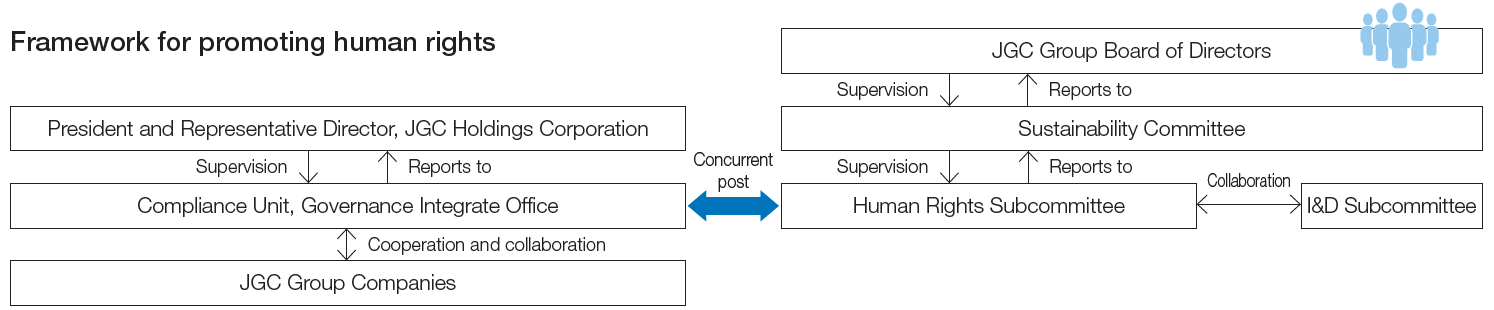
Framework for promoting human rights
Within our Group, under the Sustainability Committee chaired by our President and Representative Director, we have established a Human Rights Subcommittee to promote human rights and development. In September 2024, our Board of Directors newly established the “JGC Group Human Rights Regulations,” and under the supervision of our President and Representative Director, the Governance Integrate Office Compliance Unit took the lead in clearly defining the organizational structure to promote human rights and development throughout our Group. The Compliance Unit also serves as the secretariat for the Human Rights Subcommittee, and this Subcommittee is made up of members from across the Group. We continue to collaborate with the Sustainability Committee and the Human Rights Subcommittee to advance Group-wide initiatives for respect for human rights.
Promotion of Human rights due diligence
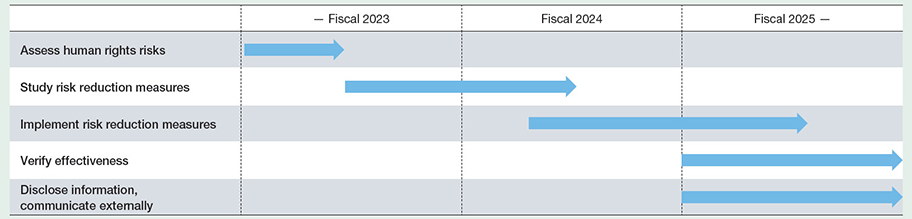
Our company follows international standards such as the United Nations “Guiding Principles on Business and Human Rights” and the Japanese government’s “Guidelines for Respecting Human Rights in Responsible Supply Chains,” and has been working to establish a human rights due diligence framework based on our Group’s Basic Policy for Human Rights & Development and our Group’s Human Rights Regulations. In our main business, EPC projects, we are working to continuously implement a series of human rights due diligence processes, by identifying and assessing human rights risks, considering and implementing risk mitigation measures, verifying effectiveness, and disclosing information.
Fiscal year 2024 initiatives
| Assess human rights risks | |
|---|---|
| Total Engineering Business |
|
| Functional Materials Manufacturing Business |
|
| Investigate and implement risk reduction measures | |
| Total Engineering Business |
|
| Functional Materials Manufacturing Business |
|
| Total Engineering Business |
|
|---|---|
| Functional Materials Manufacturing Business |
|
Hearing at construction sites ~Middle East region~
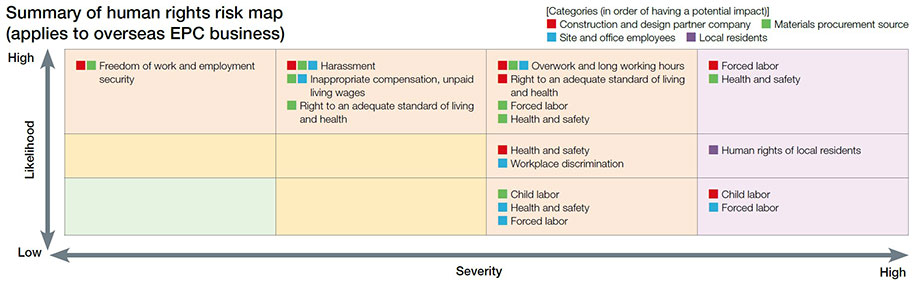
Within our Group, in order to promote human rights due diligence, we have identified overseas EPC business as an area with high risk of human rights violations in the supply chain, based on a human rights risk map created with input from external experts, and are taking focused measures to address these risks. In particular, construction sites in the Middle East have been selected as priority investigation targets due to international concerns regarding the employment and working conditions of multinational workers in the region.
In May 2025, in collaboration with the HSSE Team, we visited construction sites in the Middle East where projects are underway and conducted human rights due diligence.
Survey method
Prior to the visit, we sent questionnaires regarding human rights to partner companies and major vendors, and collected information on labor contracts, wages, hygiene conditions of accommodations, grievance mechanisms, and other related matters. On site, we conducted a survey of the working environment and engaged in dialogue with workers to identify issues related to working conditions and human rights.
Survey results
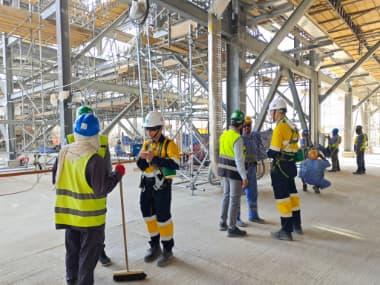
At this site, we confirmed that corrective actions are being considered and implemented in cooperation with relevant teams. As a result of the survey, we found that, thanks to the efforts of our stakeholders and the tradition of HSSE within our company, this site demonstrated good teamwork with sufficient communication between managers and workers. While there are issues arising from the labor law systems of the countries where projects are executed, and it remains necessary to pay attention to the impact on workers, we confirmed that no serious human rights risks have occurred.
Going forward, we will continue to prevent and improve negative impacts on human rights in the working environment through ongoing dialogue with stakeholders, including construction site workers.
Raising awareness of human rights through internal events
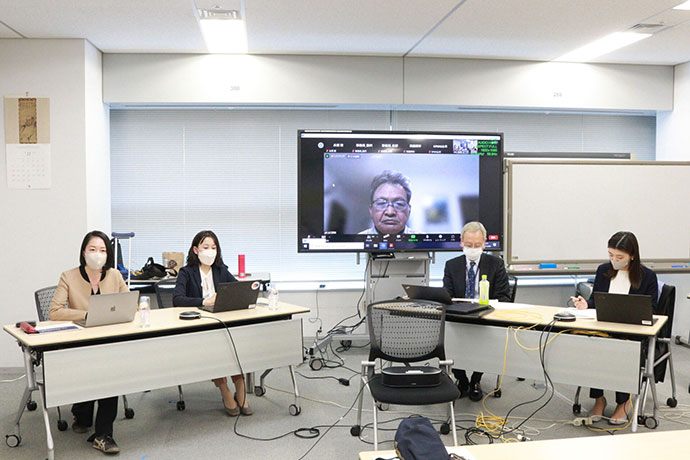
Our Group holds an annual event themed on “people” called “PEOPLE DAY”, and in 2025, the Compliance Unit also participated in the booth session. This year’s theme, “Connecting,” was addressed through a brief lecture and role play on assertive communication. In the role play, we presented both poor and good examples of scenarios such as “making a request” and “declining,” demonstrating how changing perspectives and phrasing can alter how messages are received and perceived, and help avoid harassment that denies the personhood of others. We all have the right to self-expression, and must respect the same right of others. Building a better workplace environment requires remembering the philosophy of respecting others, and we are advancing initiatives for respecting human rights through raising internal awareness.
Main initiatives
Distribution of the JGC Group Supplier Code of Conduct
The JGC Group distributes the "JGC Group Supplier Code of Conduct", a revised version of the former "JGC Vendor and Contractor Expectations" and requires suppliers to comply with its provisions.
This Supplier Code of Conduct sets forth the conditions which we would like the Suppliers to follow when conducting business with the JGC Group, particularly in key areas such as legal compliance, quality control, health and safety, and respect for human rights.
Initiatives of Building Responsibly

Established: 2017
Board and Associate Members:28 companies
Worker welfare is drawing attention in the construction and oil & gas industries, which involve high-risk work. JGC Corporation participates as a board member in Building Responsibly (BR), which aims to protect and enhance worker welfare, dignity and respect in the industry. Since 2025, our participating member has served as Vice Chair of the BR Steering Committee. BR promotes respect for worker welfare by developing policies and guidelines as international standards for the industry. Members of our Compliance Unit participated in the Bi-Annual Meeting held in Paris, France in November 2024, where they exchanged views on worker welfare initiatives with industry peers and BR stakeholders. JGC Corporation will continue to participate in BR and work to contribute to the improvement of worker welfare across the industry.
Presenting the importance of addressing human rights at construction sites, at an APEC conference
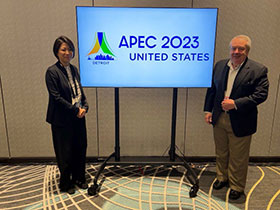
A member of the JGC Corporation Construction Department participated in APEC's Human Resource Development Working Group held in the U.S. in May 2023, and gave a presentation about IIF activities* in place at our current LNG Canada Project, and took part in the discussion session. The presentation covered on-site IIF activities, and was praised highly by BR. IIF activities at construction sites are a way of creating a working culture of ensuring care for construction workers, and help to improve Worker Welfare.
- *IIF activities: Incident & Injury Free. This is a method of creating a culture of safety on worksites, developed by safety consultant JMJ to ensure that everyone is able to return home without any injuries.
Report for Canada’s Modern Slavery Act
This Modern Slavery Report (“Report”) is published by JGC Constructors BC Ltd. (“JGC BC”) pursuant to Canada’s Fighting Against Forced Labour and Child Labour in Supply Chains Act (“Modern Slavery Act”). JGC BC is a company under the responsibility of JGC Group operating in Canada in a joint venture with Fluor Canada Ltd. for the engineering, procurement and construction of the LNG Canada Plant in Kitimat, British Columbia, Canada. This Report discusses JGC BC’s efforts to identify, prevent and reduce the risks of forced labour and child labour in its activities and supply chains within the relevant reporting period.